CTO Tech Trends & Strategies 2023
David Sewell
Chief Technology Officer,Synechron
Consulting
As we dive deeper into the second half of 2023, some emerging technology trends and strategies are ready to have their (much-earned) moment in the spotlight and be implemented to the benefit of financial services firms’ operations.
We believe four groups of identifiable emerging technologies are quite likely to receive growing investment allocations from financial services firms. These have the potential to significantly disrupt the financial services industry, and clearly demonstrate their array of positive benefits.
Here’s a look at what Chief Information Officers, Chief Technology Officers, Business Unit Heads and various other stakeholders will want to focus their energies on:
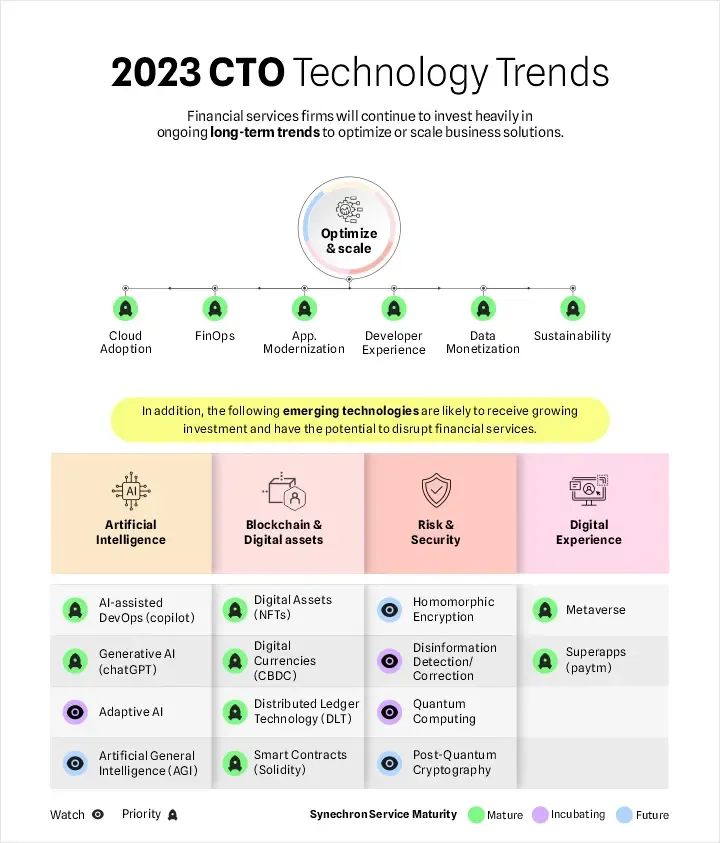
Emerging Technologies Likely to Receive Growing Investment
Artificial Intelligence
- AI-assisted DevOps (copilot) The traditional SDLC and DevOps systems and processes, enhanced with AI augmentations to address the increasing complexity of software systems and the growing demand for agility and speed of delivery.
- Generative AI (LLM & chatGPT) AI that can learn from existing artifacts (text, images, audio, etc.) and generate new, realistic artifacts that seem human-authored and reflect the characteristics of the AI training data, but don't repeat it.
- Adaptive AI AI systems that continuously learn to adapt or improve from real-world data. In traditional machine learning the AI model can't adapt or improve after the initial training.
- Artificial General Intelligence (AGI) Advances in AI that will lead to AGI systems that can understand or learn any intellectual tasks that a human can perform. Narrow AI systems lack a deep understanding of user’s unique needs, feelings and preferences.
Blockchain & Digital Assets
- Digital Assets (NFTs) Tokenized digital representation of real-world financial instruments such as bonds, securities and commodities that can have ownership and transfer of ownership recorded on a blockchain.
- Digital Currencies (CBDC) Cryptocurrencies and tokenized digital representation real-world assets such as fiat currency (central bank digital currency) and gold that can have ownership and transfer of ownership recorded on a blockchain.
- Distributed Ledger Technology (DLT) Distributed ledger technology (or blockchain) and tokenized assets (cryptocurrencies) can enable decentralized transactions without the need for intermediary banks, brokers or exchanges e.g., Decentralized Finance (DeFi).
- Smart Contracts (Solidity) “Smart” contracts are simple programs recorded on a distributed ledger or blockchain that run when predetermined conditions are met. Typically used to automate the execution of an agreement.
Risk & Security
- Homomorphic Encryption Encryption technology that allows users to perform calculations on encrypted data without first decrypting. Securing the data supply chain while allowing sensitive data to be processed on public cloud platforms.
- Disinformation Detection/Correction A combination of AI and crowdsourcing to improve the reliability of information in news, politics, business and science and improve the quality of decision making.
- Quantum Computing Computing systems that operate on the quantum state of particles to solve problems with vast complexity much faster that classical computing can achieve.
- Post-Quantum Cryptography Large-scale quantum computers will be able to break many of the current public-key encryption systems. Research has been initiating to standardize quantum-resistant public-key cryptographic algorithms.
Digital Experience
- Metaverse An immersive digital network of 3D interactive virtual worlds. Investment is growing as organizations explore how their business and customers can benefit from the technology.
- Superapps (paytm) Mobile apps that combine several micro-apps into a single seamless user experience. The superapp is built as a platform to deliver consistent and personalized app experiences.
The Author

David Sewell
Chief Technology Officer
David Sewell is Chief Technology Officer of Synechron, based in the UK. He is responsible for running the Global CTO office which supports Synechron’s business units and clients with strategy, architecture and engineering expertise that spans Synechron’s business and technology capabilities. He has more than three decades of experience as a technology and application architect and infrastructure specialist creating IT strategies and delivering solutions for many top tier banks across the financial services industry.
To learn more about Synechron’s opinions, skills and abilities on any of these mainstay and emerging technologies, or to learn how we can advise your company on ways to deploy these for business optimization purposes, please reach out to:
Synechron CTO Office: david.sewell@Synechron.com