Headless 360 Is Now AIforce: What Changed at Dreamforce '26
Amy Kenyon
US Sales Director in Synechron's Salesforce practice,Synechron
AI, Salesforce
Summary
- Salesforce grew a new head. AIforce launched on September 15 as the layer people and agents use to reach Salesforce from wherever they already work: Claude, Slack or Lightning.
- Headless 360 didn't die. It got a new job. The platform is Salesforce Platform again, and the headless plumbing (APIs, MCP, CLI) is now the Headless Toolkit, which AIforce runs on. Nothing you built in April needs rework.
- Sales Cloud is back. Around two dozen products dropped the Agentforce prefix and got their old names back, including Service Cloud and Financial Services Cloud.
- Claude got a Salesforce login. Salesforce in Claude is in open beta with 37 prebuilt sales skills, plus 40+ builder skills for Claude Code.
- The guardrails shipped with the shiny stuff. Agent Fabric, Salesforce Guardian, Agent Optimizer and now unmetered Agentforce Observability.
- The money is real. Agentforce passed $1.5 billion in annual recurring revenue, up more than 240% year over year.
- Come see it live: we're demonstrating AIforce at World Tour London, ExCeL, on October 15, 2026.
An Interface Unlike Anything You Have Ever Seen
Upon unveiling this news, Mark Benioff, Salesforce CEO said, “You will see an interface unlike anything you have ever seen before.” By the end of the keynote, it was clear he didn't just mean a new screen. He meant you may not need to go to Salesforce at all. Salesforce comes to you; in whatever tool you already have open.
In fact, most of the engineering wasn't new. In April, Salesforce opened its platform up through APIs, MCP tools and CLI commands and called it Headless 360. Five months later, that same work came back with a new name and a new spot on the architecture diagram.
So, if you built a roadmap on the April story, the fair question is:
What actually moved, and what just got a new label? Let's untangle it.
Renamed vs. Genuinely New
Headless 360 was doing two jobs, so Salesforce split it in half and added something on top.
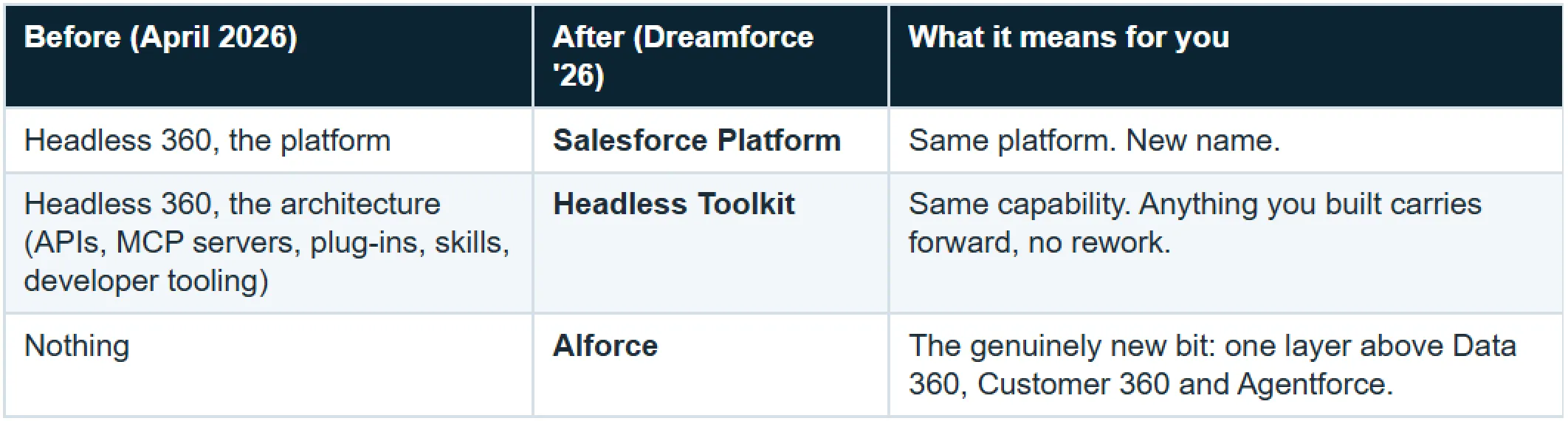
AIforce launched with three surfaces, each meeting people where they already spend their day:
- Claudeforce: The Salesforce and Anthropic partnership. Its first product, Salesforce in Claude, is in open beta with 37 prebuilt sales skills and the Salesforce Development plug-in for Claude Code adds more than 40 builder skills.
- Slackforce: Salesforce context inside Slack through Slackbot, Slack CRM, Slack Code and Slackforce Surfaces, which builds live dashboards from a plain-language ask.
- Agentforce Coworker: Generally available now. An AI teammate in the Lightning search bar that routes work to the agents a company has already deployed.
One thing that didn't happen: Agentforce wasn't swallowed by AIforce. It's still the digital workforce layer underneath, doing the actual work.
The New Stack
If you remember one picture from Dreamforce, make it this one.
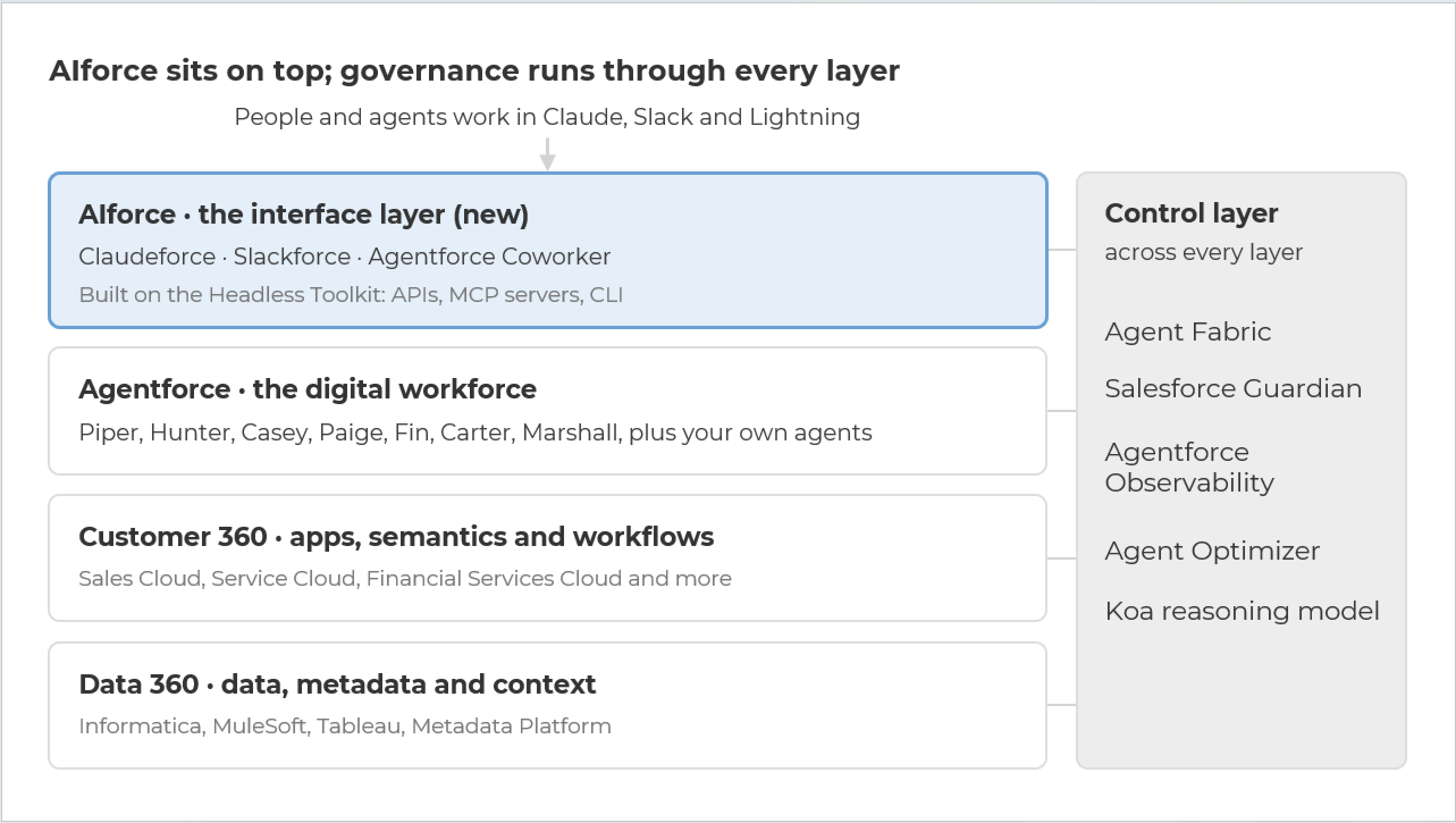 The Salesforce stack after Dreamforce '26: four layers plus the control layer
Read it top down. People and agents start in the tools they already use. AIforce carries them into the agents, apps and data underneath, and the control layer watches every step. Benioff summed it up himself, “these four layers: data, apps and semantics, agents, interface, that is what we want to transform right now.”
The Great Un-Renaming, and Why Regulated Industries Should Care
The day before Dreamforce 2026 opened, Salesforce restored the original names of most of the two dozen or so products that had picked up the Agentforce prefix a year earlier:

A day later, the AI name went somewhere else entirely: onto the interface layer.
It's more than a branding tidy-up. Read the two moves together and they tell you where Salesforce thinks its real value lives. The applications go back to the names customers trust, and the AI branding attaches to the place where work actually happens. The value sits in the platform holding your data, workflows and business rules. The interface just turns up wherever your people already are.
For banks, insurers, asset managers and other regulated firms, that changes the to-do list. If the same client data can now be reached from Claude, Slack and Lightning, your governance has to travel with it. Permissions, audit trails and approval paths that work in one interface but not another won't pass regulatory tests. Portable governance is now a design requirement from day one.
More Access Needs More Control
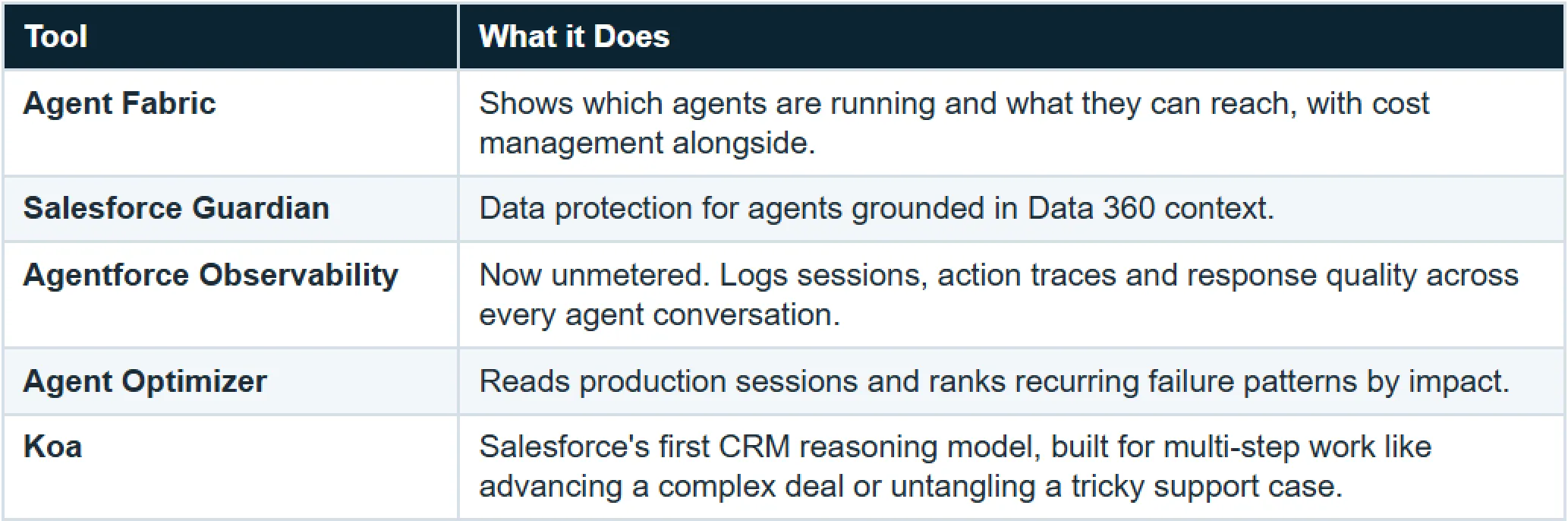
Opening new routes into Salesforce creates more to govern. Salesforce recognized that early, shipping the control layer alongside the new interface rather than treating governance as an afterthought.
The most useful stat of the week came from Salesforce's research. In its first State of Agentic AI in the Enterprise report, covering more than 2,000 AI decision-makers, the three factors most predictive of agentic success were:
- Clean, accessible data
- A narrowly scoped use case
- Escalation paths defined before launch
Each was cited by just over a third of organizations with agents deployed. Model quality, platform choice and orchestration layer all ranked lower. And 40% of organizations running agents in production are using them in high-stakes or regulated work.
In other words: The winners are the ones who did their homework and didn’t just rely on their models.
Where Synechron Makes the Biggest Difference
We’ve shipped the capability. The gap between that and something a regulated firm can safely run in production is where we live. Here are the five places we expect to make the most difference for our clients.
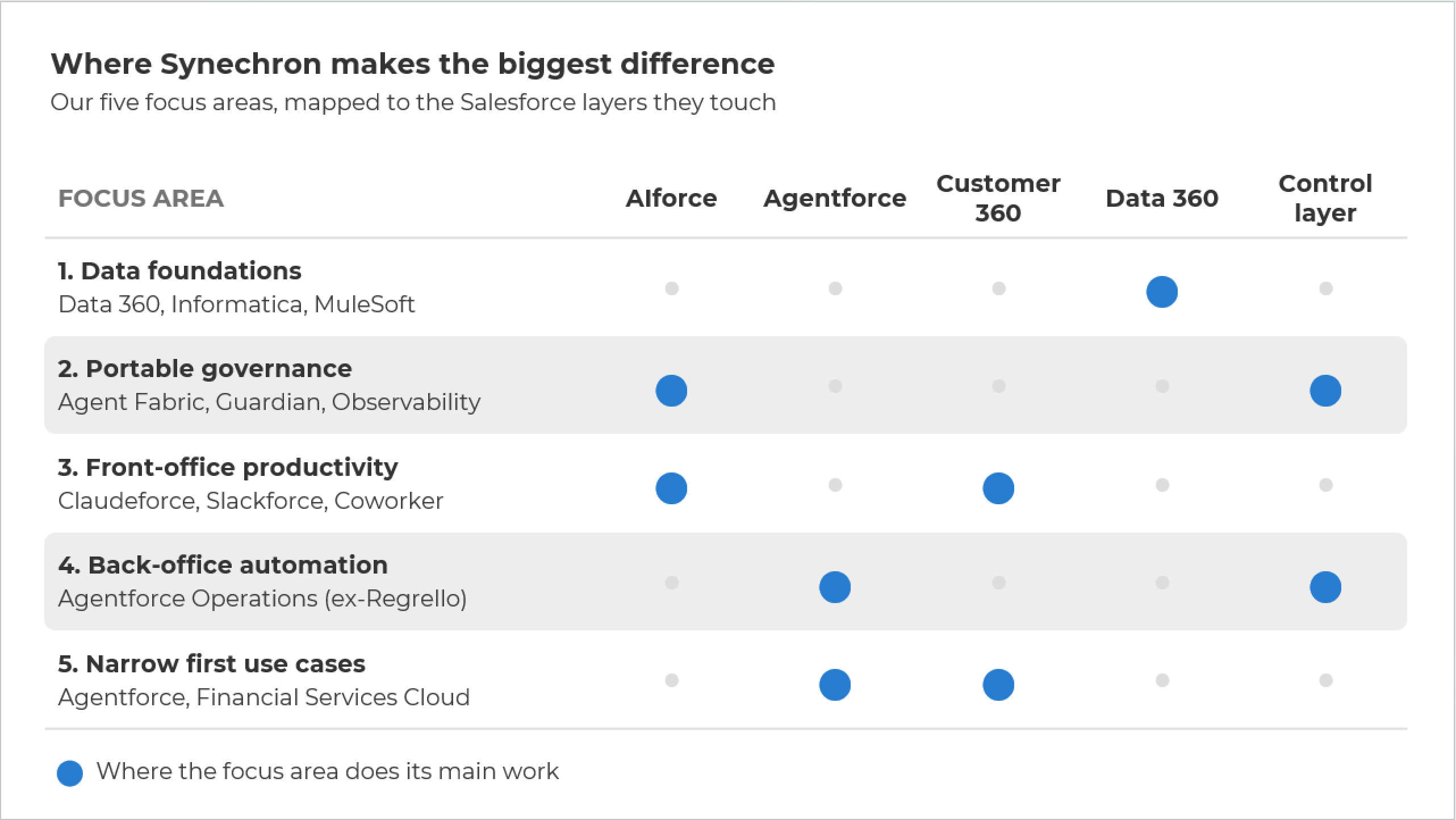
1. Getting the data house in order
Products: Data 360, Informatica, MuleSoft, Metadata Platform
Clean, accessible data is the number one predictor of agentic success, and it's the work most firms want to skip. Don't. Fulton Bank, one of the standout stories of the week, now runs 10 agents in production, has saved 80,000 hours and credits Agentforce with $389 million in loans and deposits. It got there after six years of data and process groundwork. We help clients take that same route, faster.
2. Governance that travels with the data
Products: Agent Fabric, Salesforce Guardian, Agentforce Observability, Agent Optimizer
When a relationship manager pulls a client view into Claude, compliance will ask three questions: what data could the agent reach, whose permissions did it use, and can we reconstruct exactly what happened? We design permissions, audit trails and escalation paths so the answers are the same in Claude, Slack and Lightning.
3. Front-office productivity in the tools people love
Products: Claudeforce, Slackforce, Agentforce Coworker
Bankers and advisors live in their inbox, Slack and, increasingly, Claude. We tailor the prebuilt sales skills to real workflows, like meeting prep, pipeline reviews and client follow-ups, so the people with the client relationships spend less time in screens and more time with clients.
4. Back-office automation that ships
Product: Agentforce Operations (formerly Regrello)
This is our sleeper hit of Dreamforce. Describe any process in plain English, or upload the documents and diagrams you already have, and it builds a digital blueprint of that process. It drops in pre-built agents and adds human steps wherever they're needed. Those back-office agents arrive with deep domain expertise and deterministic execution: they extract data from complex documents, update spreadsheets, run calculations and comparisons and flag delays and compliance gaps, with humans in the loop and a full audit trail for every action. For operations teams buried in manual processing, that's a big deal, and a natural place for us to lead the implementation.
5. Narrow, high-value first use cases
Products: Agentforce, Financial Services Cloud
The research is clear: narrowly scoped use cases with escalation paths defined up front beat big-bang programs. We help clients pick the first two or three agents worth building, from banking service and advisor support to insurance claims intake and prove value before scaling.
Conclusion
The interface changed. The delivery work didn't.
AIforce and Salesforce inside Claude and Slack are certainly a turning point. But the questions that matter in a regulated organization are the same ones we were asking in April: which data could the agent reach, which permissions did it use, and can we reconstruct the whole sequence later? Those answers come from how the thing is built, not from which window it shows up in.
Ready to take the next step on your Salesforce journey? We'll be demonstrating AIforce at World Tour London, ExCeL, on 15 October, and talking about what it means for regulated environments. Come find us.
Sources:
- Transcript: Marc Benioff keynote at Dreamforce 2026
- Computer Weekly: Dreamforce 2026, Marc Benioff beats customer data drum
- UC Today: Dreamforce 2026 keynote, AIforce and the end of the interface?
- Salesforce Ben: Biggest Dreamforce '26 announcements
- Salesforce: Dreamforce '26 media resources
- Atrium: Dreamforce 2026 financial services takeaways
- AX3: Dreamforce 2026 recap
The Author

Amy Kenyon
US Sales Director in Synechron's Salesforce practice
Amy Kenyon is US Sales Director in Synechron's Salesforce practice, where she leads client growth across the firm's financial services, private equity and technology accounts. With numerous years of experience in technology sales, Amy takes a consultative approach, partnering with clients to understand their goals and building strategic business cases that show clear ROI. She works closely with the Salesforce ecosystem, building relationships with Salesforce account executives and sales leaders, as well as other ISV partners, to deliver solutions that help organizations modernize and grow.