Salesforce's Two-Model Bet
Kedar Budukh
Principal Technical Architect
Salesforce
Claudeforce is now a working product, but Salesforce is hedging with its own model, Koa, so buyers should plan for both
Summary
- Claudeforce has moved from a keynote demo to a working beta that teams use to answer questions from their own Salesforce records.
- Regulated firms can use it because Claude runs inside Salesforce's Trust Boundary with zero data retention.
- Salesforce's own model, Koa, is likely to take routine CRM work and leave Claude the open-ended reasoning.
- Customers pay two separate bills, and the Flex Credit price isn't set yet, so budget for it now.
Back in August, Salesforce's Marc Benioff and Anthropic's Dario Amodei announced Claudeforce, pairing Anthropic's Claude with Salesforce's CRM. Two months on, it's a product real teams use, folded into a bigger Salesforce strategy currently called SIforce. If you filed this under “check back later,” this is the check-back.
Picture a seller's Monday, the old way. Deciding which five deals need attention means opening the pipeline, clicking into each opportunity, scrolling activity history and stitching it all into a plan by hand. Salesforce's Patrick Stokes calls this “10,000 clicks”: 30 seconds of thinking buried under 20 minutes of navigating screens built for data entry.
Claudeforce flips that. The seller asks, "Which deals need attention today, and why?" Claude reads the same records under the same permissions and answers in under a minute, building a dashboard on the spot if that explains it better. Nobody configured that screen in advance. It exists because someone asked for it. That is what "headless" Salesforce means: the screens still exist, but they are no longer the only way in.
The difference is easiest to see side by side.
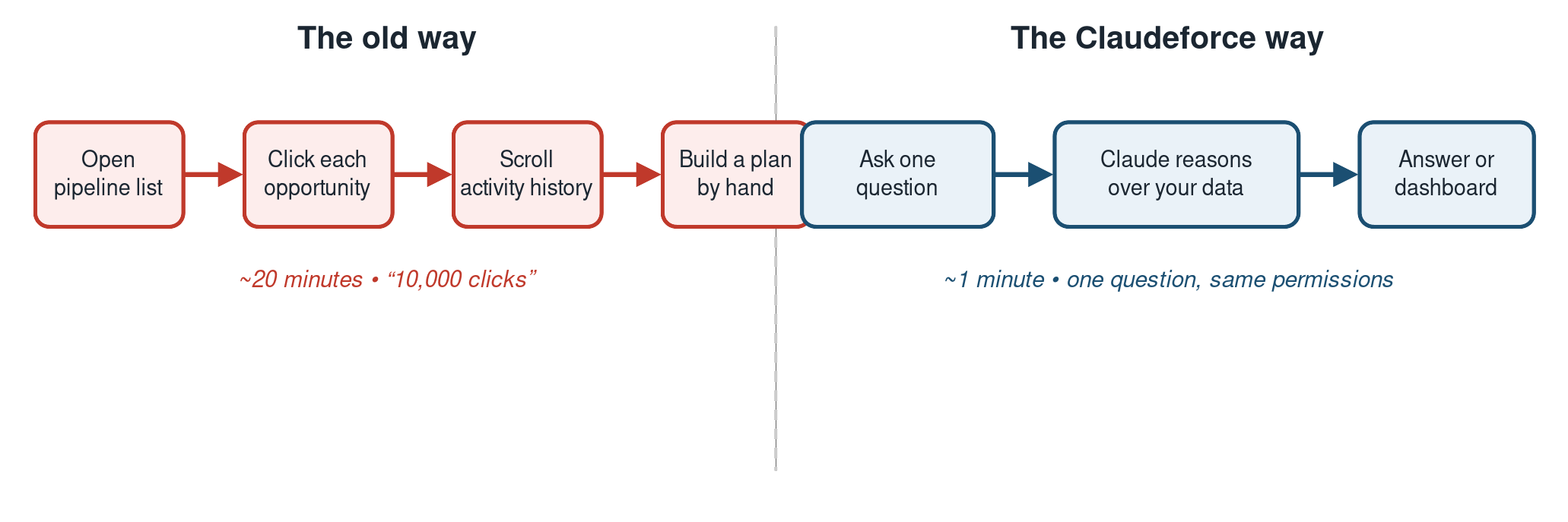 The old way takes about 20 minutes of clicking; Claudeforce takes one question and about a minute
Three Things Are Live
Salesforce in Claude is a plugin your admin switches on once, company-wide. It ships with 37 ready-made skills for tasks like meeting prep and pipeline reviews, and it has moved from a small pilot into open beta for every customer. Everyone sees only what their own Salesforce login already allows.
Claude inside Salesforce is the reasoning engine behind Agentforce Coworker and other tools, right inside your Lightning screens. Claude inside Slack lets a deal-channel conversation update a Salesforce record directly, with no app-switching. All three reach the same system.
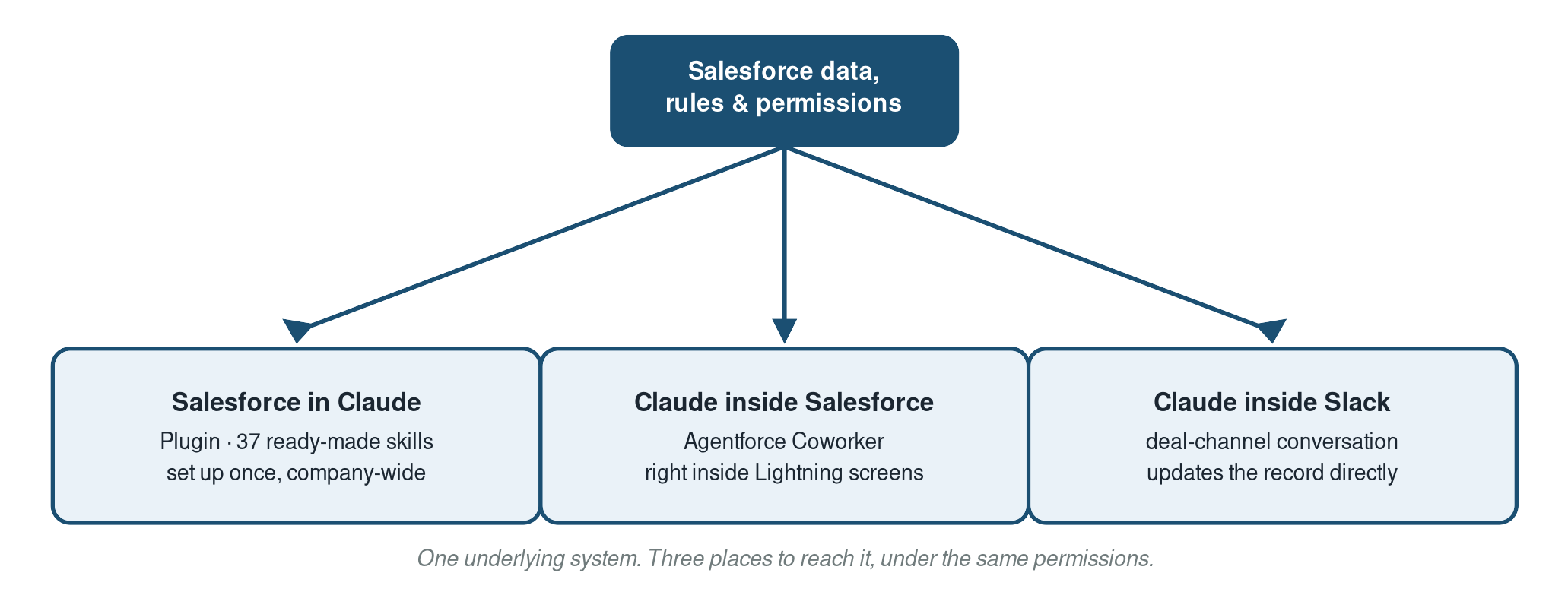 One underlying system with three places to reach it, under the same permissions
Where Does Your Data Go?
This decides whether banking or healthcare can touch any of this.
Your Salesforce data sits in a secure building your company already trusts. Sending it to a typical outside AI means photographing the contents and mailing the photos to someone else's office. Amazon Bedrock works differently: it runs Claude inside the customer's own secured environment. Salesforce calls this its "Trust Boundary." Claude gets invited in, answers the question and leaves. Nothing gets mailed out.
The second half, confirmed at Dreamforce 2026, is zero data retention. Claude doesn't keep a copy of what it saw, and it isn't learning from your records for next time. Used once, then gone.
The trust model is easier to follow as a picture.
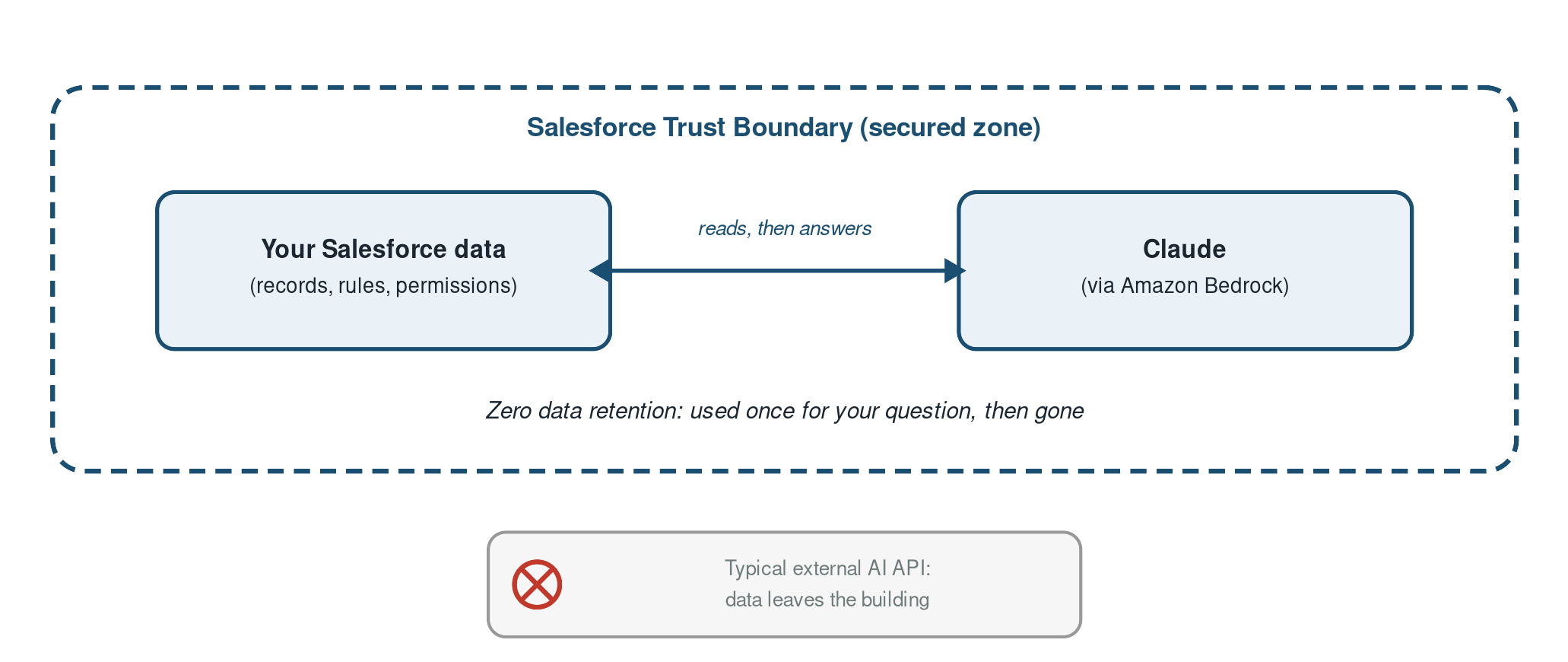 Claude works inside Salesforce's Trust Boundary, while a typical external AI API takes data out of the building
Financial services is the one industry named specifically, building on work from late 2025. RBC Wealth Management already uses it to cut advisor meeting-prep time. Telecommunications, media and energy haven't had that treatment yet, and nothing sector-specific is built for them. The plumbing applies to what you run today.
Koa And The Routine Work
Dreamforce's bigger surprise wasn't about Claude. Salesforce, with NVIDIA, unveiled its own reasoning model for Agentforce: Koa.
Koa is built on NVIDIA's open Nemotron model, then trained further by Salesforce on synthetic scenarios drawn from 27 years of its own CRM know-how. No customer data went into training it. Salesforce says Koa beats general-purpose models on CRM tasks, with three times fewer errors by its own benchmark. Unlike Claude, Salesforce owns Koa's weights outright and runs it on its own infrastructure. It's in pilot now, with general availability expected this winter in the US.
Nothing's official, but the shape is a reasonable guess. Koa is built for the high-volume, repetitive CRM work Agentforce runs constantly, such as scoring leads and routing cases, and it's likely cheaper to run. Claude's edge stays where Koa wasn't built to go: open-ended reasoning beyond CRM data, the chat experience in Claude itself, and heavier thinking inside a Slack discussion. Unconfirmed, but the pricing below gives Salesforce every reason to push routine work toward its own model.
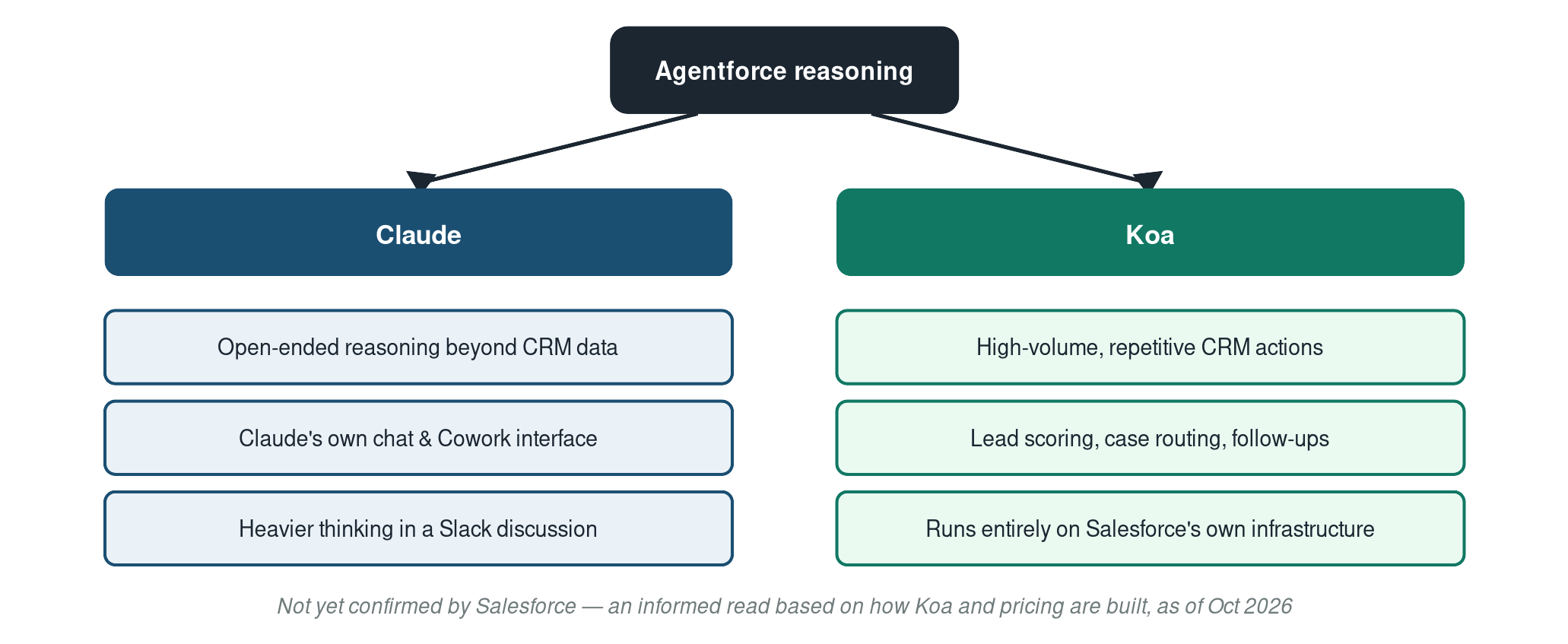 How Agentforce reasoning could split between Claude and Koa, not yet confirmed by Salesforce
Two Companies, Two Bills
This part is confirmed. Anthropic's own setup documentation says Salesforce in Claude requires a minimum Salesforce Sales Cloud Enterprise Edition subscription, and the plugin runs on any paid Claude plan. You need a paid relationship with both companies before this works at all. Salesforce invoices you for the Sales Cloud license, and Anthropic invoices you for the Claude plan.
On top of that, Salesforce is introducing a separate charge called Flex Credits, metered per agentic action taken against its platform through MCP or API calls. The price per action hasn't been published, and Salesforce has promised 30 days' notice before metering begins. Salesforce hasn't confirmed by name that Flex Credits will apply to Salesforce in Claude. The plugin runs on exactly the kind of MCP traffic Flex Credits is built to meter, so budget for it rather than assume it won't apply.
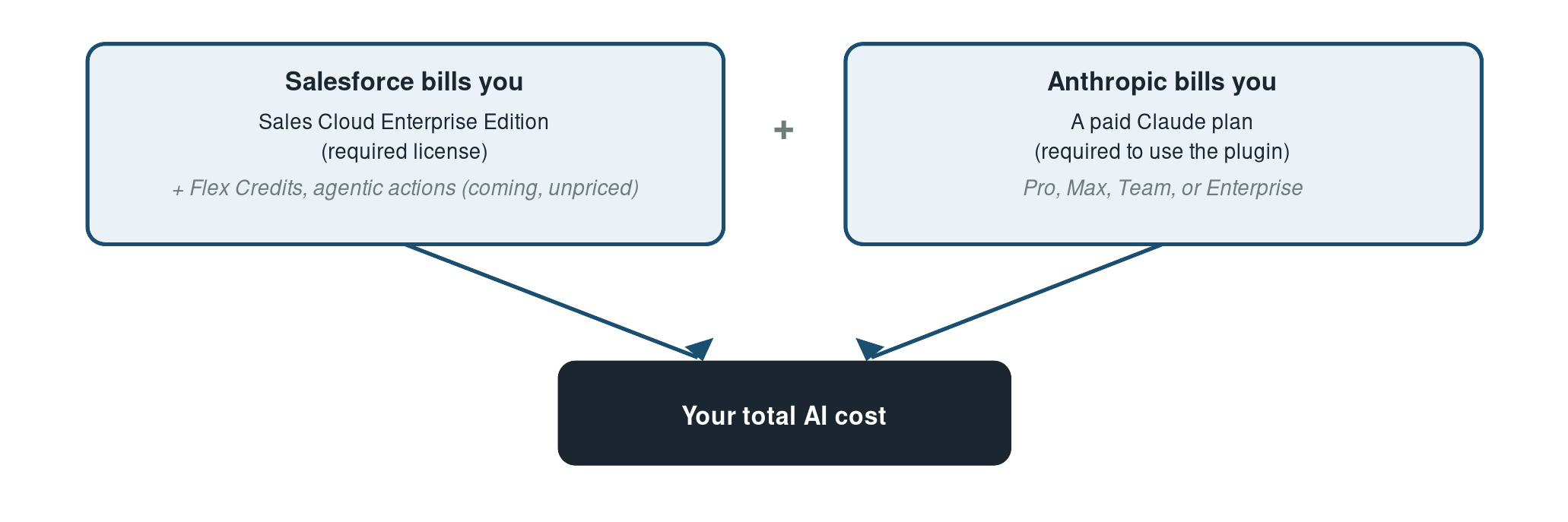 Your total AI cost comes from two separate invoices, one from Salesforce and one from Anthropic
What This Means For Your Seat
If you deliver this as a partner or architect, audit permissions before an agent touches them, then add write access one skill at a time. If you use Salesforce day to day, not much changes about what you're allowed to do. Treat Claude's answers as a strong first draft, not gospel, especially in beta. If you sign off on budget, confirm how the Trust Boundary and zero data retention apply to your contract, and get ahead of Flex Credit pricing before metering starts. Keep a second model configured in Agent Builder. Salesforce is hedging with Koa, and your architecture should too.
Where This Leaves Us
Claudeforce stopped being a keynote slide around September. It's a working beta, with a Salesforce-built rival waiting in the wings and two bills to budget for. For financial services, the ground is solid. Everywhere else, the architecture is ready and the specifics are still being written, which is the right time to pay attention. To see how this applies to your own Salesforce environment, get in touch with our Salesforce experts.
The Author

Kedar Budukh
Principal Technical Architect
Kedar is a Principal Technical Architect at Synechron and a data science and AI enthusiast. He is passionate about building the future of data with Salesforce Data Cloud and Agentforce.
Kedar is TOGAF-certified and a Telecom industry thought leader. He specialises in lead-to-cash transformation, product catalog rationalisation, CPQ and order management. He is also a Data Cloud and Agentforce enthusiast, blending AI-driven innovation with best practices to deliver scalable, future-ready Salesforce solutions.