

Summary
2026 is the year AI becomes an operating model.
Agentic systems are moving beyond assistive tasks to orchestrate, govern and execute end‑to‑end workflows safely and at scale. Advantage no longer rests on the “best model,” but on enterprise control planes: orchestration, governance‑as‑code and deep business context accessible through secure, API‑first integrations. This whitepaper outlines the agentic operating model, what changes in software economics, how to build credible production‑grade autonomy and the practical roadmap to run digital coworkers with confidence. Synechron helps enterprises implement robust control planes, continuous evaluation, and AgentOps to turn autonomy into measurable outcomes.
Highlights


Production‑grade autonomy changes the enterprise calculus.
The first wave of AI improved personal productivity; the next transforms business productivity. We’re now able to design systems that understand enterprise context, coordinate across applications and execute entire workflows — with controls baked in.
That’s why the center of gravity is shifting from “best model” to best‑run operating model. Autonomy requires orchestration, governance‑as‑code and clear economic guardrails. You need a control plane that treats agents like a workforce: scoped permissions, auditable actions, escalation paths and continuous evaluation.
At Synechron, we’ve spent years preparing for this moment across financial services and complex operations. This paper is pragmatic by design. It focuses on what it takes to deliver outcomes in production, not proofs‑of‑concept. I hope it helps your organization to harness agentic AI with greater confidence.
Synechron CTO
Contents
Introduction
Agentic AI is quietly reshaping how enterprises operate. OpenAI reports that weekly enterprise AI usage is deepening, with reasoning‑token consumption per organization having grown by 320% in the past 12 months. Despite this, only 23% of companies report scaling agentic AI anywhere in the enterprise. In short, now is the time to get ahead of the curve when it comes to agentic adoption.
Digital coworkers are already planning, coordinating and executing entire workflows. The real differentiator is no longer the model, but the organizations capable of running autonomous operations with confidence. As work shifts from human‑led to AI‑led execution, performance gains compound: faster cycles, fewer errors, tighter controls, lower costs. This demands orchestration, governance and new operational roles built for autonomous systems.
The enterprises prepared for this shift aren’t adapting, they’re advancing.

- Forbes
The Paradigm Shift
Humans still pushed the work forward, clicked the buttons and closed the loops.
We're now entering the next phase:
Agentic AI, where systems can plan, coordinate and execute full processes, not just offer suggestions. These agents behave like digital coworkers, capable of making decisions within defined boundaries and accountable for outcomes rather than prompts. This changes the centre of gravity from personal productivity to business productivity. Instead of improving isolated tasks in a single application, enterprises can redesign how work flows through the organization.
Why This Matters for Your Organization
Three forces make this shift not just exciting, but urgent:
AI is becoming an operating model, not a feature
Enterprises are investing in agentic control planes: Centralized systems that manage governance, context, orchestration and execution. In this model, advantage doesn't come from the "best model", it comes from the ability to orchestrate work across systems, enforce trust and guardrails and make quality data available to agents at scale.
Software economics are changing
As AI takes on more of the execution, value moves away from per-seat tools and toward API-first, headless architectures where agents interact directly with core systems. Pricing shifts from user licences to pay-for-action or outcome-based models, rewarding efficiency and measurable results.
Credibility now comes from production, not pilots
Enterprises are growing more sceptical of proofs of concept that never scale. The differentiator will be organizations that can demonstrate production outcomes, faster cycle times, lower error rates, reduced cost and fewer risk events, delivered by agentic workflows built on robust controls, not experimentation alone.
The New AI Operating Model
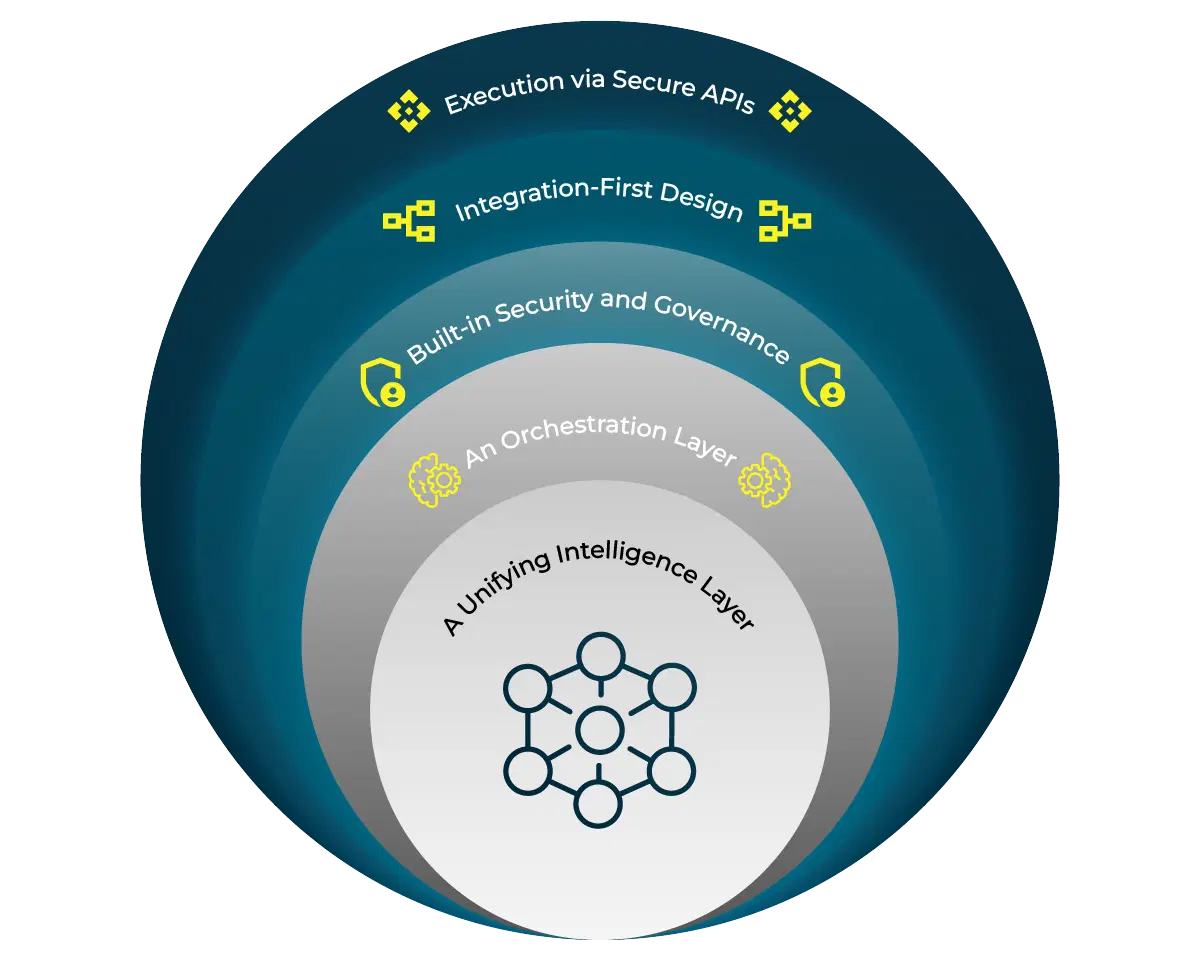
- A unifying intelligence layer: Agents need access to semantic business context, the relationships between data, workflows, systems, and business rules. This shared context allows agents to make decisions that align with how the business works.
- An orchestration layer: This is the brain of the system, coordinating how tasks are assigned, sequenced and supervised. It prevents duplication, manages dependencies and ensures agents don’t collide or work at cross-purposes.
- Built-in security and governance: The model must integrate scoped permissions, audit logs, compliance controls and guardrails. With agents acting autonomously, governance cannot sit on the sidelines. It must be embedded directly into how agents operate.
- Integration-first design: Agents integrate with existing systems through secure APIs rather than relying on UI automation. This drastically improves reliability and makes adoption feasible without large‑scale data migration.
- Execution via secure APIs: Agents interact directly with systems of record, performing actions, updating data, resolving tasks and triggering workflows exactly as human users would —but programmatically, with consistency and auditability.
The Agentic Operating Model in Practice
The organizations that succeed with agentic AI will build an agent control plane, supported by the following layers:
This layered structure transforms autonomous agents from a risky novelty into a safe, scalable digital workforce.
Governance as Infrastructure
Key principles include:
- Human accountability: Agents may perform the work, but humans remain responsible for outcomes, meaning every agent must operate with a clearly defined mission, scope and boundary, with escalation paths that route uncertain or high-risk decisions back to people.
- Risk bounding: Agents require tightly scoped permissions, least‑privilege access, throttles, budgets and kill switches so that their autonomy is always constrained within safe, measurable limits, preventing unintended actions or uncontrolled execution.
- Traceability and auditability: Every agent action (decisions, tool calls, API interactions, memory read/writes) must be captured in end-to-end audit logs, ensuring transparency, accountability and the ability to investigate or roll back behavior when needed.
- Fail‑safe mechanisms: Agents must be engineered to fail safely rather than silently, using deterministic kill switches, rollback and retry strategies and containment zones that isolate errors before they propagate across systems or workflows.
- Continuous evaluation: Agents need ongoing scenario-based stress testing and regression checks, both at pre‑deployment and at runtime, ensuring performance, reliability and safety remain consistent as workflows evolve and business context changes, forming the backbone of effective AgentOps.
- Gartner


Sam Altman
CEO of OpenAI
The Workforce Shift
As agents automate more work, the human operating model changes too. New roles are emerging. There is now a business need for AI Orchestration Specialists and AgentOps Managers; professionals who are on side to integrate, monitor and govern agent fleets. They ensure performance, safety, compliance and cost control, treating AI agents as an operational workforce, not as a set of tools. Talent and operating model maturity will become crucial differentiators as organizations scale their agentic capabilities.
The Economics of Agentic AI
Traditional software and staffing models don't hold up when agents perform increasing portions of enterprise work. Per-seat licensing declines because agents reduce the number of human "seats," and value shifts away from headcount-based pricing. Value pools also change, shifting concentration to data and context layers, orchestration systems, governance and control planes and outcome-based services. The legacy SaaS model isn't disappearing, but it is being realigned around execution.
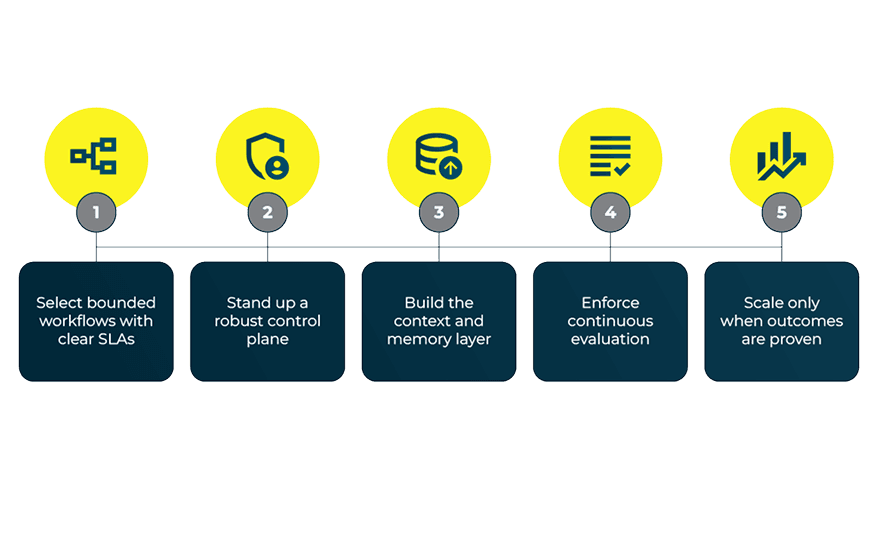
A Practical Roadmap to Execution
- Select bounded workflows with clear SLAs
- Stand up a robust control plane
- Build the context and memory layer
- Enforce continuous evaluation
- Scale only when outcomes are proven
This creates a safe, repeatable, governed path to enterprise‑grade agentic AI.
Conclusion
At Synechron, we've been preparing for this inflection point for years. Our work across financial services, technology and operations has shown that autonomous workflows only succeed when engineering discipline, governance‑as‑code and deep domain knowledge come together. We help clients stand up control planes, shape enterprise context layers, embed continuous evaluation and design the AgentOps capabilities needed to run digital coworkers with confidence.
As agentic AI becomes an operating model, not a feature, Synechron is uniquely positioned to guide organizations through this transition, turning autonomy into measurable business outcomes, and ensuring that enterprises lead the next decade of operational transformation, rather than reacting to it.
Key Definitions
Sources:
https://knowledge.wharton.upenn.edu/special-report/2025-ai-adoption-report/
https://www.gartner.com/en/newsroom/press-releases/2025-06-25-gartner-predicts-over-40-percent-of-agentic-ai-projects-will-be-canceled-by-end-of-2027
https://www.forbes.com/councils/forbestechcouncil/2026/02/19/agentic-ais-missing-ingredient-context-aware-data/
https://www.deloitte.com/us/en/what-we-do/capabilities/applied-artificial-intelligence/content/state-of-ai-in-the-enterprise.html
https://openai.com/index/the-state-of-enterprise-ai-2025-report/