What Mythos Reveals About Modern Cyber Risk
Eklove Mohan
Senior Director,North America, Synechron
AI
Summary:
- Mythos has exposed a new cybersecurity blind spot: vulnerabilities hidden within complex application workflows that traditional security tools often miss.
- Legacy banking systems are particularly exposed, with decades of interconnected code, business logic and technical debt creating risks that may not appear in standard scans.
- Synechron developed RAPID to identify and validate vulnerable execution paths by analyzing how applications operate, rather than treating code as isolated components.
- As Mythos-class capabilities become more common, organizations that gain visibility into hidden exposure today will be better prepared to remediate risk tomorrow.
For years, banks have measured cyber risk through a relatively familiar lens. Vulnerabilities are discovered, catalogued, prioritized and patched. Security investments have focused on improving visibility into known threats and reducing the time required to remediate them. For financial institutions, where decades-old core systems continue to support critical business processes, maintaining visibility into risk is particularly important. The challenge is that many of those environments have evolved over years of enhancements, integration and regulatory change, making it increasingly difficult to identify where unknown vulnerabilities may exist.
Then Mythos arrived.
Earlier this year, Anthropic introduced Mythos Preview, a cybersecurity-capable frontier model that demonstrated an unusual ability to identify previously unknown vulnerabilities hidden inside mature software systems. During testing, Anthropic reported that Mythos was able to identify and exploit zero-day vulnerabilities across every major operating system and web browser, while also achieving full control-flow hijack on ten fully patched targets in internal security evaluations. It reportedly uncovered vulnerabilities that had survived years (and in some cases decades) of testing, multiple security scans, code review and production use.
For technology leaders, the important question is: What does Mythos reveal about enterprise software?
If a frontier AI model can uncover vulnerabilities that traditional approaches have missed, organizations must confront an uncomfortable possibility: the greatest source of cyber risk may not be the vulnerabilities they know about. It may be the vulnerabilities nobody has discovered yet.
Why Legacy Technology Suddenly Matters Again
This challenge is particularly relevant for banking.
Many institutions still rely on technology estates that have evolved over decades. Core banking platforms, payment systems, customer onboarding journeys and operational processes often depend on layers of applications developed across multiple technology generations.
These systems aren't inherently flawed; the problem is their complexity.
Over time, applications become interconnected. New channels are layered onto old platforms. APIs are introduced. Authentication models evolve. What begins as a straightforward application gradually becomes a web of dependencies, trust relationships and business logic.
This is why Mythos has attracted so much attention within financial services. The concern is not that banks suddenly became insecure overnight. The concern is that long-running, business-critical platforms may contain vulnerabilities that have remained invisible simply because existing approaches were never designed to find them.
The Limitation of Looking at Applications in Pieces
Traditional application security tools remain essential. Static analysis, dynamic testing and dependency scanning all play an important role in reducing risk.
The challenge is that they often evaluate application code based on known vulnerable patterns with no insight into the application business flow. That’s one of the fundamental reasons for “false positive” issues reported by these tools.
Modern attacks rarely operate that way.
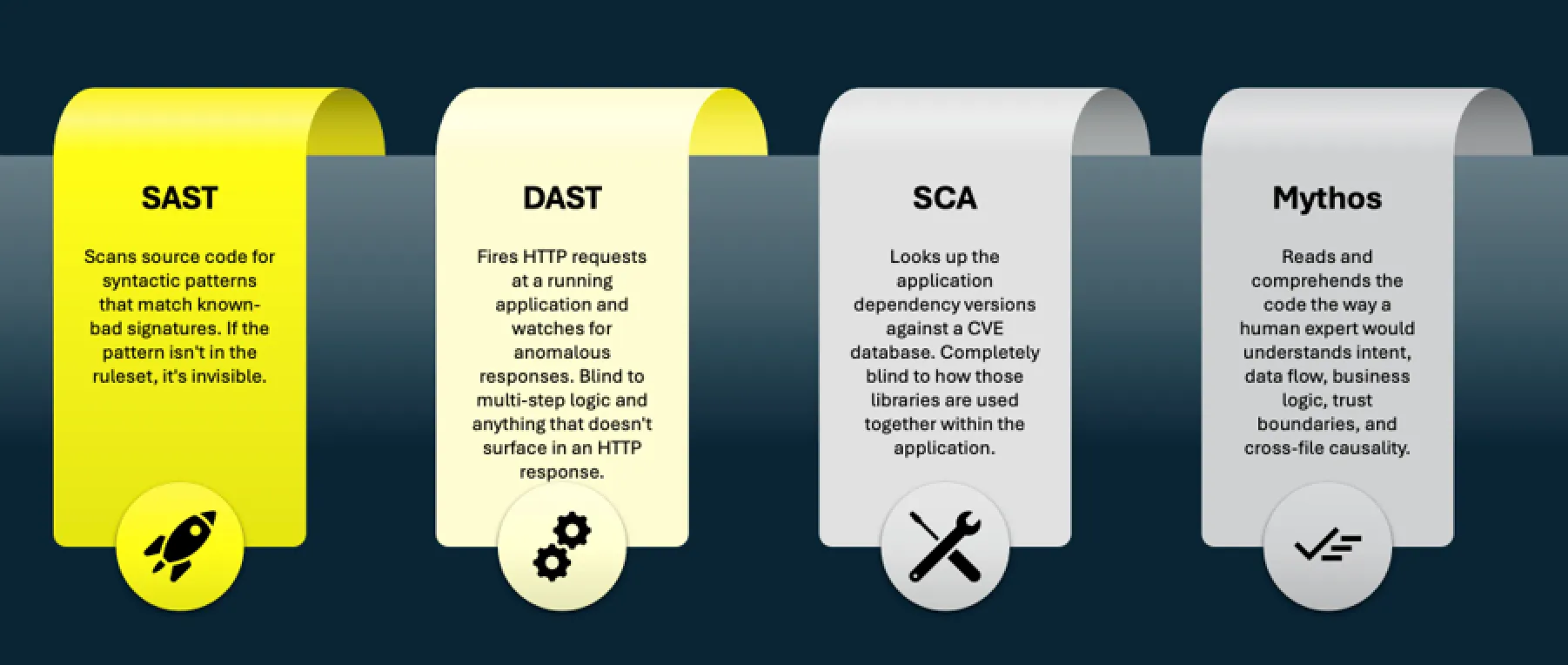
Traditional vulnerability scanning vs. Mythos detection.
Risk increasingly emerges across connections: an authentication flow linked to an overlooked permission model, a data pathway that crosses trust boundaries, or a sequence of legitimate application behaviors that collectively create an opportunity for exploitation.
Public information about Mythos suggests a different approach. Rather than analyzing isolated sections of code, the model appears capable of reasoning across broader execution paths, tracing how data, permissions and business logic interact throughout an application.
That shift matters because many of the most difficult-to-detect vulnerabilities do not exist within a single line of code. They emerge from the way systems work together.
A customer login, for example, is not a single event. It is a chain of interactions between applications, services, permissions and data. Understanding whether that chain can be exploited requires visibility across the entire flow, rather than just the individual components.
Synechron RAPID: Looking Beyond Known Vulnerabilities
The significance of Mythos-class models is not the number of vulnerabilities it detects. In fact, security teams are already overwhelmed with findings.
What’s significant is that Mythos-class models point to a future where previously unknown vulnerabilities can be discovered through contextual reasoning, rather than just pre-defined rules or known signatures.
This is the challenge that inspired RAPID.
Rather than focusing solely on individual findings, Synechron built RAPID to analyze connected execution paths and help organizations understand where risk exists within the context of the wider application. Inspired by emerging Mythos-style approaches, it is designed to identify, validate and prioritize vulnerabilities before moving into remediation and testing.
Rather than producing another list of alerts, RAPID creates a connected view of how risk moves through an application. It maps exploit paths, validates whether exposure is real and provides the evidence required for teams to investigate and act with confidence.
In one public open-source test, RAPID identified additional vulnerabilities beyond those already documented in publicly reported records while filtering out suspected false positives before presenting findings for human review. This served as a reminder that publicly reported vulnerabilities may represent discovered risk rather than total risk.
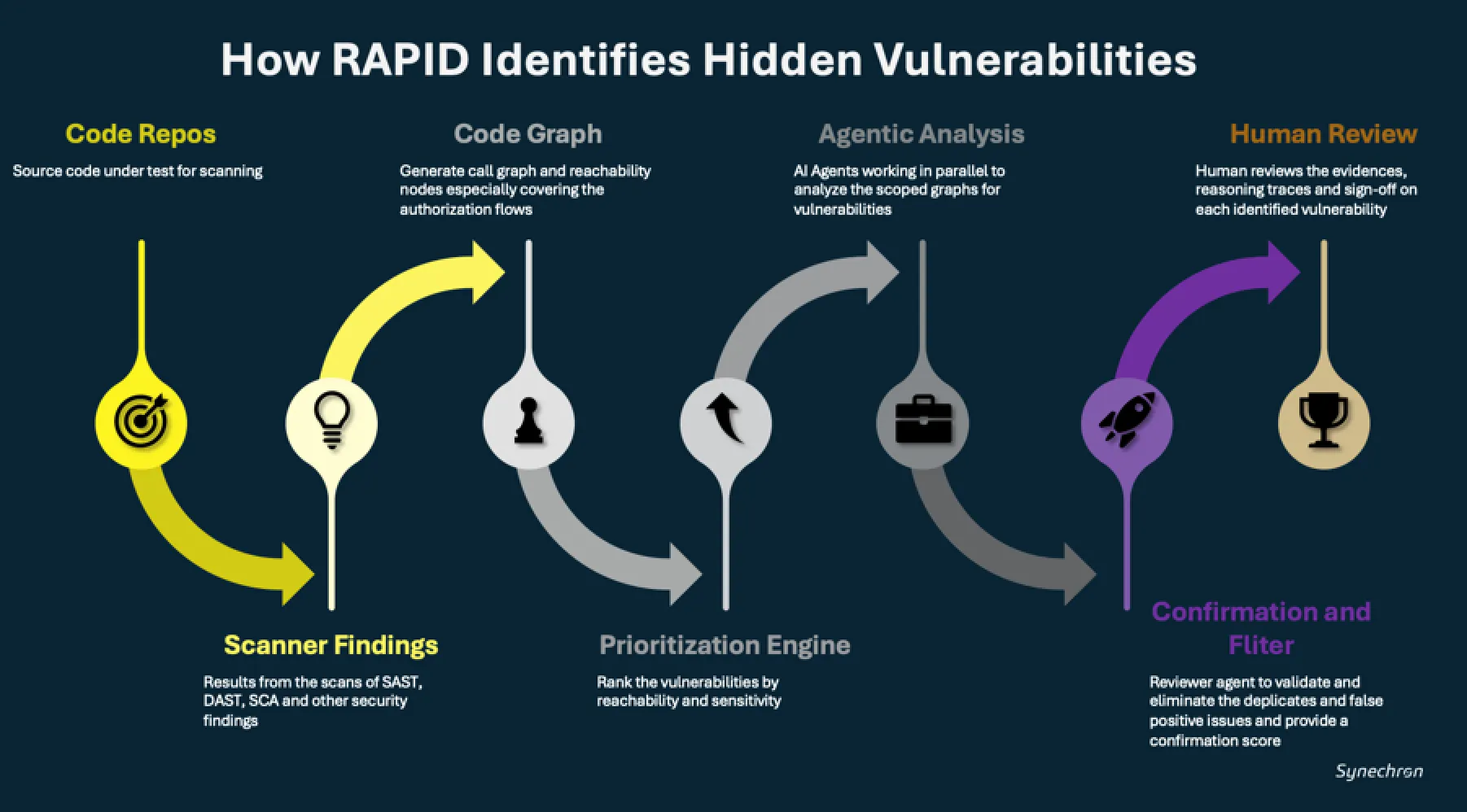
RAPID combines code analysis, graph-based mapping and AI-driven reasoning to understand how applications operate.
The key takeaway here is the possibility that publicly reported vulnerabilities represent a record of discovered risk, rather than a complete inventory of existing risk.
Preparing Before the Market Catches Up
Whether Mythos itself becomes the defining cybersecurity model of this generation is almost beside the point.
What matters is that Mythos-class models have highlighted a shift many technology leaders already suspected: there are likely vulnerabilities inside critical systems that existing approaches cannot easily see. The models capable of finding them will only become more powerful, more accessible and more widely adopted.
The organizations that benefit most from this shift will not be those chasing perfect security.
They will be the organizations that improve visibility into their technology estates today, develop the ability to identify and remediate risk more quickly, and prepare for a world where vulnerability discovery increasingly happens at machine speed.
Because when Mythos-class capabilities become commonplace, the competitive advantage will come not only from knowing vulnerabilities exist, but from already knowing where to find them.
The Author

Eklove Mohan
Senior Director
Eklove Mohan is a Senior Director in the North America CTO office at Synechron. His work focuses on application security, agentic AI systems, cloud computing, and enterprise architecture. His recent work includes designing AI-integrated technical architectures for financial services spanning claims, fraud, and underwriting, combining real-time and batch processing with generative AI and agentic workflows. Eklove writes on emerging topics at the intersection of agentic AI, LLM security, and enterprise-grade AI adoption. He is based in Virginia, USA.