Why Chasing Perfect Data is Stalling Your AI Readiness
Tim Jennings
Global Head of Data,Synechron
AI
Summary:
- Many organizations see AI readiness as a data quality challenge, but enterprise AI often struggles more with understanding business meaning, definitions and context.
- AI can produce plausible answers from accurate data while still arriving at the wrong conclusion if it cannot distinguish between different business definitions, rules or relationships.
- Ontology provides a shared business language by capturing concepts, relationships and business rules, helping AI interpret enterprise data consistently and appropriately.
- As organizations move towards agentic AI, making business knowledge explicit through semantic context and ontology becomes increasingly important for trusted, explainable and scalable AI outcomes.
Introduction
For the past two years, discussions about AI readiness have largely centered on one question: Is the data good enough?
This concern is understandable. Organizations have spent decades investing in data quality, governance and modernization. As AI adoption accelerates, it seems logical that better data should be the key to better AI.
Yet, many organizations pursuing AI have discovered something uncomfortable. Data quality, while important, is rarely the issue preventing progress. Most large enterprises are already operating successfully using the data they have. They process transactions, manage risk, serve customers and meet regulatory obligations every day. If data quality was fundamentally inadequate, those businesses would already have much bigger problems.
The challenge emerging in AI is something different.
It is a challenge of meaning.
As organizations move from copilots and chatbots into "talk to my data" and agentic AI use cases, they are encountering a problem that traditional data programs were never designed to solve. AI can access information. What it often lacks is an understanding of how that information should be interpreted.
The Hidden Risk in Enterprise AI
One of the assumptions shaping enterprise AI is that incorrect answers are primarily caused by poor data.
In practice, many of the most significant risks emerge when AI is working with perfectly legitimate data.
Consider a simple business question: what was our revenue last quarter?
The answer sounds straightforward. It rarely is.
A sales team may define revenue one way. Finance may define it another. Reporting teams may use adjusted figures designed for entirely different purposes. Each answer can be valid within its own context. The complication is that the word "revenue" appears consistent while the business meaning behind it changes depending on who is asking and why.
Humans navigate these distinctions instinctively. Years of experience teach people which definitions apply in which situations.
Agents do not have that advantage.
Presented with multiple valid interpretations, an agent system may choose one, generate a confident answer and provide no indication that alternative definitions exist. The output can be accurate according to one interpretation while being entirely unsuitable for the decision at hand.
That is a fundamentally different problem from data quality.
The data may be correct. The calculation may be correct. The answer may still be wrong for the purpose it is being used for.
Enterprise Knowledge Was Never Designed for Machines
The root of the issue is that organizations store data and knowledge in very different ways.
Enterprise systems are extremely effective at recording transactions, customers, products, claims, trades and accounts. They are far less effective at capturing the assumptions, business rules and contextual understanding that experienced employees apply every day.
That knowledge often lives elsewhere.
It exists in process documentation, policy manuals, regulatory guidance, application logic and operational experience. Sometimes it exists only in the heads of the people who understand how the business works.
A finance professional understands when a report should not be run. A risk specialist understands which classifications cannot coexist. A trader understands why a particular figure makes no sense despite appearing mathematically correct.
Much of that understanding never makes its way into the data itself.
The result is a growing gap between what an organization's data says and what the organization actually knows.
As AI begins to support more analysis, recommendations and autonomous actions, that gap becomes more important. Agents can only work with the context they have been given. Where business knowledge remains implicit, the quality of the outcome depends increasingly on educated guesswork.
Why Ontology Matters
This is why ontology is moving from a niche data-management concept into a strategic AI conversation.
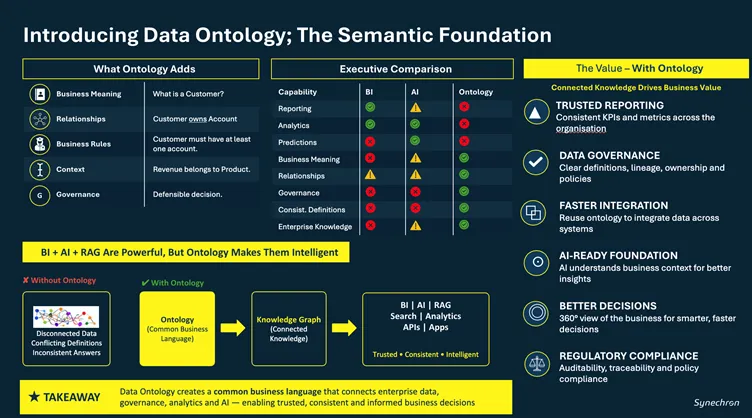
Most organizations already have the knowledge agents need. It exists in business glossaries, policy documents, process manuals, data catalogs and the experience of subject matter experts. The problem is that this knowledge is fragmented, applied inconsistently and rarely available in a form that agents can use directly.
Ontology creates a structured layer that sits above the underlying data and captures the business meaning surrounding it. It defines key concepts, establishes relationships between them and records the rules that govern how they should be interpreted and used. Rather than exposing agents to raw tables, fields and documents alone, it provides the context needed to understand what the data represents.
In practice, that means concepts such as customers, accounts, products and revenue are connected through shared definitions and business rules. Revenue is no longer simply a field in a database; it is linked to the definition, relationships and constraints that explain how it should be used. Business rules that employees apply through experience become explicit and reusable across reporting, analytics and AI.
Importantly, this doesn't require organizations to model the entire enterprise from day one. The most effective approach is usually to begin in a bounded domain such as finance, trading, claims or customer servicing, establish the critical concepts and rules, and test how AI performs when that additional context is available. Those domains can then be expanded and connected over time.
The objective is not to create a perfect representation of the business. It is to ensure agents are operating from the same understanding as the people using it.
Building Agents on Shared Meaning
The conversation around AI readiness needs to evolve. Data quality still matters. Governance still matters. Neither of those priorities disappears.
But they do not answer a critical question: Do my AI agents understand what the organization already knows?
As AI moves closer to decision-making, automation and autonomous action, that question will become increasingly important.
The organizations that create the most value from agents may not be those with the largest data estates or the most advanced models. They will be the organizations that can translate business knowledge into shared meaning using an ontology layer, creating a foundation where data, people and AI operate with the same understanding of the business.
The Author

Tim Jennings
Global Head of Data
Tim Jennings is the Global Head of Data Practice at Synechron with over 30 years in capital markets and financial services. He works with firms to advise on data strategy and architecture, helping them stay current with emerging technology and evolving market trends. His depth of experience across the industry means he understands both the technical and business drivers of effective data organisations and management.