LangGraph for Enterprise: Building Reliable Multi-Agent AI Workflows
Clayton Pilat
Head of AI, ANZ,Synechron
AI
Article Overview:
- LangGraph is becoming the enterprise standard for multi-agent AI workflow orchestration, with adoption from BlackRock, J.P. Morgan, and Klarna.
- Enterprises need agentic systems that manage state, handle failures and integrate safely, moving beyond single-prompt AI into production-grade workflows.
- The biggest barriers to adoption are orchestration complexity, prototype-to-production gap, and scarce specialist talent.
- Agentic Studio by Synechron is a visual workflow builder that accelerates LangGraph development without proprietary lock-in or per-seat licensing.
- The result: faster delivery, lower engineering overhead and a scalable path from experimentation to production using agentic AI.
Enterprises are waking up to a simple truth: The era of the single prompt is over. As AI shifts from experimental demos to real business systems, organizations are increasingly embracing agentic architectures; orchestrated workflows where multiple AI agents collaborate, coordinate and make decisions across complex processes. Modern enterprises need AI that can reason, sequence, remember and act with reliability. They need systems that behave like workflows, not one-off conversations.
This is where the work truly begins, and where most teams get stuck.
Why Enterprises Are Moving to Orchestrated, Multi-Agent Systems
Across industries, enterprises are realizing that meaningful automation demands more than prompting, it requires systems that can manage state, coordinate complex workflows and integrate safely with real business operations. LangGraph’s software development kit provides exactly that foundation, enabling teams to build reliable, multi‑agent, multistep applications with durable execution and built‑in human oversight.
This isn’t speculative momentum. LangGraph has already proven itself in production with organizations like BlackRock, J.P. Morgan and Klarna, who rely on its state management, resilience and repeatability to power real‑world agentic workloads.
That traction is why LangGraph is quickly becoming the default standard for enterprise‑grade agentic development.
Emerging agentic runtimes now support real operational environments, with step flows, branching logic, failure recovery and secure integration into core systems. They enable multi‑agent systems with durable execution and in‑the‑loop controls, allowing organizations to grade use cases effectively and demonstrate viability at scale.
The Delivery Challenge: Complexity, Talent Gaps, and the Prototype to Production Chasm
But even with the right framework, delivering agentic systems at the enterprise level remains difficult.
Building orchestrated workflows in LangGraph requires specialized engineering skillsets, people who understand concurrency patterns, agent interfaces, graph-based state models and the nuances of stepwise execution. As teams experiment, they run into familiar barriers:
- Orchestration complexity: Multi-agent logic quickly balloons into sprawling graphs that are hard to debug or evolve.
- Prototype-to-production gaps: What starts as a clever notebook experiment often collapses when reliability and governance enter the picture.
- Scarce specialist talent: Teams need engineers who understand both agentic frameworks and enterprise integration patterns, which is a rare combination.
These are solvable problems, but not without the right scaffolding. Even with a standardized SDK like LangGraph, every team ends up building things differently, creating inconsistencies and duplicated effort across the organization.
What “Good” Looks Like in Enterprise Agentic Delivery
High-performing AI engineering teams share a common set of success enablers:
- Repeatable patterns so projects don’t start from scratch each time.
- Faster iteration cycles, supported by clear visualizations and reusable components.
- Consistency across teams, reducing delivery variability.
- Enterprise grade readiness, ensuring workflows are debuggable, observable, resilient and secure.
LangGraph already delivers stateful graphs, streaming, checkpoints and durable execution, that form the backbone of enterprise agentic systems. But teams still need a way to assemble these workflows at speed.
Introducing Agentic Studio: A Visual Workflow Builder for LangGraph
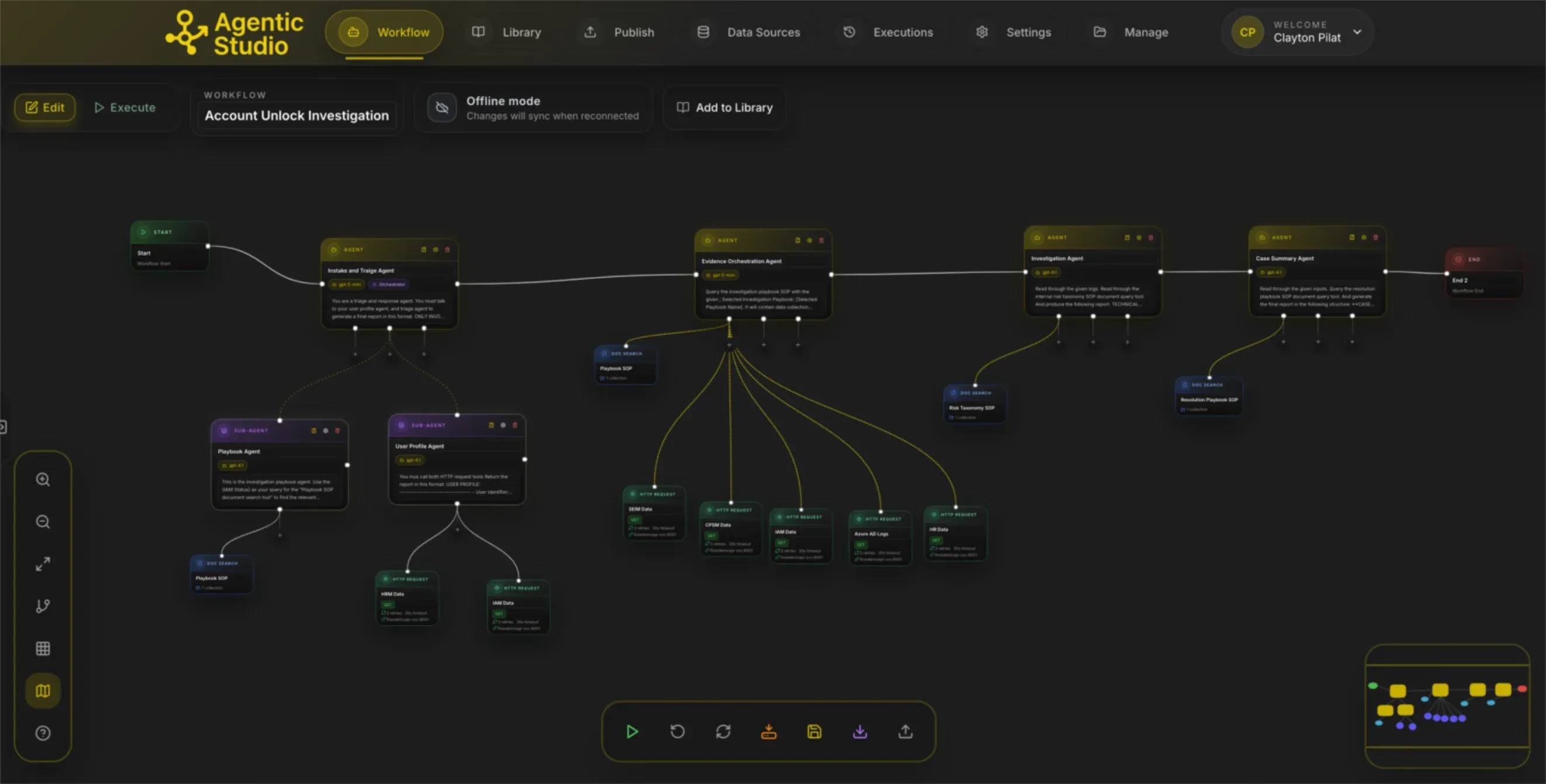
Agentic Studio, part of the broader Synechron Agentic suite, brings a much-needed visual layer on top of LangGraph. It gives engineering teams a way to design, assemble and iterate multi-step, multi-agent workflows using an intuitive, visual builder, all while staying fully native to the LangGraph execution model.
Think of it as accelerating everything that makes LangGraph powerful, while removing the friction that typically slows teams down.
Agentic Studio enables teams to:
- Compose complex workflows more quickly, reducing orchestration overhead.
- Visualize and debug execution flows, making it easier to understand graph behavior, dependencies and decision points.
- Standardize patterns across engagements, ensuring repeatability and consistency.
- Iterate faster, shortening the cycle from idea to production-ready graph.
Most importantly, it helps enterprises close the skills gap by allowing more engineers, not just specialists, to work effectively with agentic architectures.
Why This Matters Commercially
Many visual workflow tools in the market offer strong usability, but they come with licensing implications that don’t fit every enterprise. They’re also often tied, implicitly or explicitly, to a specific cloud ecosystem. Agentic Studio, by contrast, is Synechron‑owned IP, hyperscaler‑agnostic and delivered to clients as an accelerator rather than a commercial product.
That means enterprises get:
- Comparable usability to leading workflow builders.
- A LangGraph native foundation (no lock-in, no proprietary runtimes).
- Accelerated delivery without licensing constraints.
From a commercial standpoint, this fundamentally changes the economics of agentic AI delivery. Instead of incurring repeated per-seat or per-workflow fees, clients gain a scalable, reusable asset that speeds up engineering velocity across all their LangGraph initiatives.
The Bottom Line
The future of enterprise AI is agentic. But the organizations that will win are the ones who can operationalize that future, not just experiment with it.
Agentic Studio accelerates enterprise adoption of agentic AI by making LangGraph workflows easier to build, govern and scale. It reduces engineering effort, strengthens risk controls, eliminates licensing overheads and creates a standardized orchestration layer that teams across the organization can rely on.
For large institutions, this means faster delivery, lower cost of ownership and a clear path from experimentation to production-ready agentic systems.
The Author

Clayton Pilat
Head of AI, ANZ
Clayton Pilat is an experienced AI engineer with deep expertise in analytics and machine learning. At Synechron, he is Practice Lead for AI across Australia and New Zealand, driving strategic data initiatives and solving complex challenges in financial services and technology. He combines strong technical foundations with a passion for innovation to deliver measurable impact.